What is outcome-based pricing?
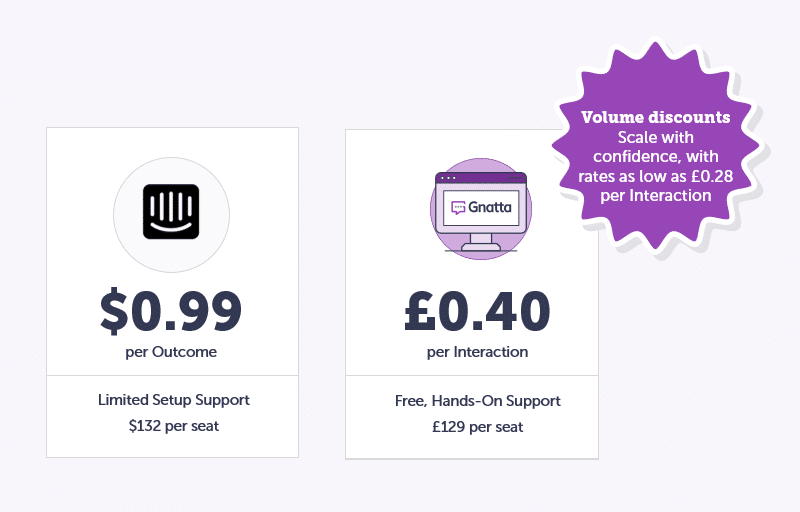
Outcome-based pricing shifts AI billing away from usage and toward perceived value delivered. As of March 2026, Intercom prices its AI (Fin) based on Outcomes rather than resolutions.
It’s not the only provider taking this approach. Platforms like Zendesk and Gorgias use similar models, charging per Resolution — typically defined as a customer issue handled successfully by AI without human intervention.
While terminology differs (Outcomes vs Resolutions), the principle is the same: you are charged based on a defined measure of successful automation.
What counts as an Outcome?
An outcome typically includes:
- A fully AI-resolved conversation
- A successfully completed AI process
- Certain structured interactions where the AI delivers a defined result
However, not every AI interaction becomes an outcome:
- Some customer-led escalations are not billed
- The exact classification depends on configuration
On first analysis, a pricing model like this seems fair and balanced. If an AI interaction doesn’t meet the criteria for an outcome — for example, it escalates to a human outside of a specific process — you’re not charged. Those interactions are effectively “free” from an AI pricing perspective.
But this is where the model becomes more nuanced, because what qualifies as an outcome is tied directly to how “successful” your AI is. That means the proportion of billable interactions increases as your automation improves.
- Early stage AI → fewer outcomes → lower cost
- Mature AI → more outcomes → higher cost
What is interaction-based AI pricing?
Interaction-based pricing (used by platforms like Gnatta) is simpler – you’re paying for all of your AI usage, but at a much lower unit cost. That means:
- Every AI conversation = one predictable unit of cost
- No dependency on how “successful” the AI was
- No ambiguity in billing definitions
This model aligns closely with contact volumes – a metric every customer service team already understands and tracks. That means it’s easier to forecast, simpler to explain and justify internally, and more stable as AI usage scales. Usage based models like this also typically start with a lower unit cost, creating a more accessible point of entry for teams beginning their AI rollout.
Learn more about AI Agent Interaction Pricing here.